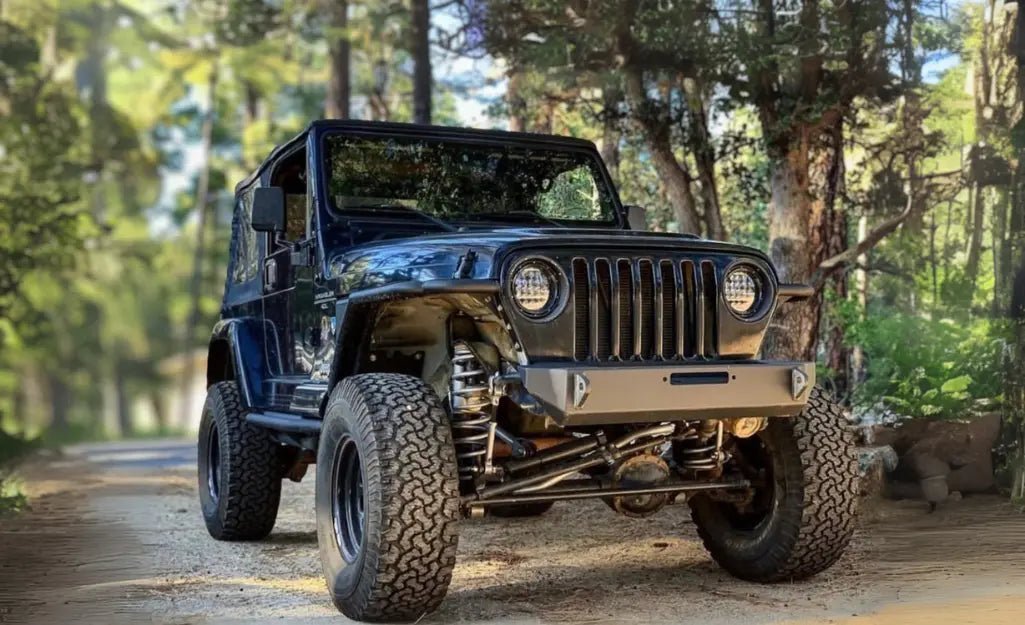
The Jeep Wrangler vs Ford Bronco debate comes down to heritage, hardware, and how you plan to use the vehicle. Both are body-on-frame-style, removable-roof, trail-rated 4x4s, but they take different approaches to off-road capability. The Wrangler starts around $32,000–$33,000 for the two-door Sport, while the Bronco begins around $40,000–$41,000 for the Big Bend trim — a gap worth understanding before you choose sides.
Key Takeaways
- The Wrangler Rubicon 392 offers a 6.4L V8; no Bronco matches it for factory power in a trail package.
- The Bronco Wildtrak‘s standard Bilstein position-sensitive dampers and front stabilizer disconnect give it an edge in high-speed desert running.
- The Wrangler’s Sway Bar Disconnect is electronic on Rubicon; the Bronco’s is a manual dashboard switch.
- The Bronco’s G.O.A.T. Modes (Goes Over Any Type of Terrain) simplify traction selection for newer off-roaders.
- Both offer locking front and rear differentials when properly equipped; the Wrangler Rubicon’s lockers engage at the push of a button.
- The Wrangler’s removable doors and fold-down windshield remain unique; the Bronco’s roof removes but its doors do not.
Suspension and Axles Compared
The Wrangler Rubicon uses Dana 44 front and rear axles with a 4:1 low-range Rock-Trac transfer case, giving a crawl ratio around 84:1 with the manual transmission. The Bronco Badlands also runs Dana AdvanTEK-style axles with available lockers, but its 2.7L-equipped models use a 3.06:1 low range, producing a lower overall crawl ratio than the Wrangler’s.
| Feature | Wrangler Rubicon | Bronco Badlands/Wildtrak |
|---|---|---|
| Front and rear lockers | Standard, electronic | Available, electronic |
| Low range | 4:1 (Rock-Trac) | 2.7:1–3.06:1 |
| Stabilizer disconnect | Electronic sway bar disconnect | Manual front disconnect |
| Dampers | Fox racing shocks | Bilstein position-sensitive |
Ground Clearance and Angles
The Wrangler Rubicon 4-door posts roughly 10.8–12.9 inches of ground clearance depending on tires, with an approach angle near 43–47 degrees. The Bronco Badlands with the Sasquatch Package (35-inch tires) reaches about 11.5–11.6 inches of clearance with comparable approach and departure angles. The Sasquatch Package’s 35s are standard on Wildtrak; Wrangler buyers need the Extreme Recon Package for similar rubber.
Which Has Better Traction Tech?
The two differ in philosophy. The Wrangler’s Selec-Speed Control manages throttle and braking on descents, and the Rubicon’s Trail Rated pedigree leans on mechanical hardware. The Bronco counters with G.O.A.T. Modes — up to seven settings including Baja, Rock Crawl, and Mud/Ruts — plus Trail Turn Assist, which brakes the inside rear wheel to tighten the turning radius, and Trail Control, a cruise control for off-road use.
Pro Tip: If you’re new to wheeling, the Bronco’s mode system does more of the thinking for you. Experienced drivers often prefer the Wrangler’s direct mechanical control.
Engine and Powertrain Options
| Engine | Wrangler | Bronco |
|---|---|---|
| Base 4-cylinder turbo | 2.0L, ~270 hp | 2.3L, ~300 hp |
| V6 option | 3.6L Pentastar, ~285 hp | 2.7L twin-turbo, ~330 hp |
| Hybrid | 4xe plug-in, ~375 hp | None |
| V8 | 6.4L, 392, ~470 hp | None |
The Wrangler is the only one of the two offering a manual transmission (with the 3.6L V6), a plug-in hybrid, and a V8. The Bronco answers with the Raptor variant, whose 3.0L twin-turbo V6 makes around 418–440+ hp and is tuned for high-speed desert terrain.
Water Fording and Durability
The Bronco advertises up to 33–35 inches of water fording depth with the Sasquatch Package; the Wrangler 4xe manages about 30 inches, and gas models slightly less. Both use sealed electrical systems and high-mounted air intakes designed for trail crossings. Underbody protection is strong on both: skid plates cover the transfer case, fuel tank, and suspension components when properly equipped.
Roof, Doors, and Open-Air Design
The Wrangler holds the advantage. Its doors come off with basic tools, the windshield folds flat, and the Freedom Top hardtop splits into three panels. The Bronco’s roof removes in sections and its B-pillars can come out, but the doors stay on.
Jeep and Ford Off-Road Trim Lineups for Wrangler and Bronco
| Trim | Wrangler | Bronco |
|---|---|---|
| Entry trail trim | Sport/Sport S | Big Bend |
| Mid trail trim | Sahara/Willys | Black Diamond |
| Rock-crawling flagship | Rubicon | Badlands |
| Desert/maximum performance | Rubicon 392 | Raptor |
Each brand also sells purpose-built editions — the Wrangler Willys and Bronco Everglades (with a winch standard) — aimed at specific terrain types.
Which One Should You Buy?
Choose the Wrangler if you want maximum configuration options, a manual gearbox, a hybrid, or a V8, and you value the deepest aftermarket support in the segment. Choose the Bronco if you want modern tech, better on-road manners, standard 35-inch tires at the top trims, and easier traction management. Both will handle challenging trails; the difference is in how they get there.
Related guides
Frequently Asked Questions
Is the Bronco better than the Wrangler off-road?
Neither dominates outright. The Wrangler Rubicon’s 4:1 low range and Dana 44s favor slow rock crawling, while the Bronco Wildtrak and Raptor excel at speed over rough terrain.
Which is more reliable, Wrangler or Bronco?
Both have mixed reliability records. The Wrangler has a longer track record; the Bronco, launched in 2021, has had early-production recalls.
Can the Bronco remove its doors like a Wrangler?
No. The Bronco’s mirrors are door-mounted and its doors aren’t designed for removal. Its roof panels do remove, giving strong open-air feel, but the Wrangler is the only one with fully removable doors and a fold-down windshield.
What is the Sasquatch Package?
It’s a Bronco option package adding 35-inch tires, beadlock-capable wheels, front and rear locking differentials, shortened springs, and high-clearance fender flares. It’s standard on Wildtrak and Raptor and available on most other trims.
Does the Wrangler still offer a manual transmission?
Yes, the six-speed manual remains available with the 3.6L V6 on certain Wrangler trims. The Bronco dropped its manual after early model years, so the Wrangler is currently the only choice between the two.
Conclusion
For a true comparison, drive both back-to-back on the same trail day — many off-road parks and dealership events rent Wranglers and Broncos by the hour. That single outing will tell you more about ride, visibility, and control than any spec sheet can.