
As an Amazon Associate, we earn from qualifying purchases. This post contains affiliate links – if you buy through them, we may earn a commission at no extra cost to you.
Best overall: 70mai M310 Plus offers true 4K front clarity and smart pre-recording for complete incident capture. Best dual camera setup: Affver 4K+2.5K Dash Cam gives you sharp front and rear views with fast WiFi transfers. Best budget value: Dash Cam 4K+1080P provides dual recording and GPS without requiring extra card purchases upfront.
How We Picked
We focused on seller guarantees.
1. 70mai M310 Plus 4K Dash Cam Front with Night Vision

Best for: Drivers who want the sharpest single-lens footage.
True 4K helps read license plates. The 140° wide angle covers most of the road. Enhanced night vision uses an F1.55 aperture.
Voice control lets you lock videos without taking your hands off the wheel.
Pros
- True 4K resolution captures fine details well
- Pre-recording saves crucial moments before crashes
- Voice control adds safe hands-free operation
Cons
- Parking mode requires buying a hardwire kit
- No rear camera included in the box
2. Affver 4K+2.5K Dash Cam Front and Rear

Best for: Families needing front and rear coverage.
The large 3.59-inch screen makes checking settings easy. The low-profile design keeps your windshield clean.
Pros
- Fast WiFi 6 speeds for quick downloads
- Includes 64GB card and extra charger port
- Large screen simplifies menu navigation
Cons
- Rear camera cable routing takes time
3. Dash Cam 4K+1080P

Best for: Buyers wanting dual lenses on a budget.
Loop recording handles storage management automatically, locking important clips when needed. The 5GHz WiFi ensures smooth video transfers to your app.
Pros
- Comes with a 64GB card included
- Dual lenses cover front and rear views
- Fast 5GHz WiFi reduces download lag
Cons
- Smaller 2.0-inch screen limits review ease
4. 4K Dash Cam Front and Rear Inside
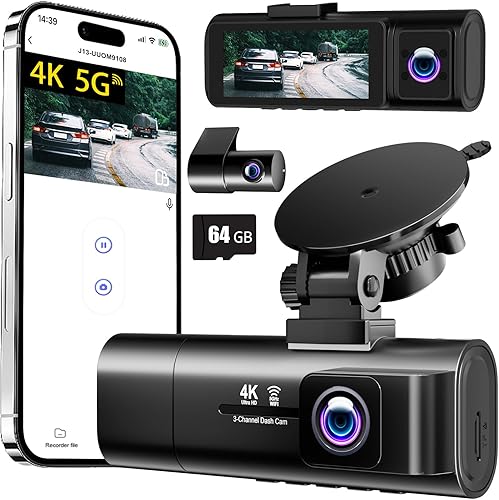
Best for: Rideshare drivers tracking inside and out.
Records front, rear, and interior simultaneously. Three lenses provide total visibility. 4K front with 1080P for other angles.
It includes a 64GB card and uses 5GHz WiFi for fast downloads.
Pros
- Three lenses cover exterior and interior
- IR night vision aids cabin recording
- Free app access for all video features
Cons
- Interior lens is only 1080P resolution
- Hardwire kit sold separately for parking
5. galphi 4K Mini Dash Cam

Best for: Minimalists who hate screens.
You manage everything through the app via 5GHz WiFi, which keeps transfers quick. Night vision uses a large aperture to handle low-light conditions well. If you prefer tactile buttons over apps, this might not suit you.
Pros
- Screenless design reduces driver distraction
- Compact form factor fits anywhere easily
- High-speed wireless connection ensures fast clip downloads
Cons
- No screen means settings changes via app only
- Smaller 32GB card included initially
6. Veement V200Pro 2.5K WiFi Dash Cam with 1.47-Inch IPS Screen
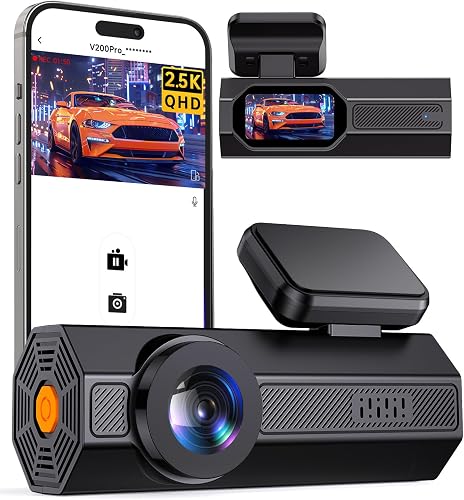
Best for: First-time users wanting simplicity.
F1.6 aperture balances lights in night shots. Reliably records the road ahead. No GPS or rear cameras.
Pros
- Simple setup ideal for beginners
- Small screen shows key status info
- Reliable basic recording performance
Cons
- No GPS or rear camera options
- Very small screen limits detailed review
7. Dash Cam Front Inside

Best for: Rideshare drivers monitoring passengers.
WiFi lets you download clips without removing the card. The screenless design keeps things tidy on your windshield. It includes a 32GB card for immediate use.
Pros
- Simultaneous front and cabin recording
- IR LEDs ensure clear night cabin views
- Screenless design keeps windshield clean
Cons
- No screen for quick local checks
- Interior resolution lower than front lens
8. 1080P Dual Dash Camera

Best for: Those needing the most affordable option.
Installation is quick with a suction cup mount. The night vision sensor activates automatically in low light. If you need high-res evidence or app features, look elsewhere.
Pros
- Includes 32GB card for immediate use
- Simple suction cup installation process
Cons
- Only 1080P resolution on both lenses
- No WiFi or GPS connectivity features
9. Dash Cam Front and Rear

Best for: Commuters wanting reliable dual coverage.
Pairs 2.5K front and 1080P rear lenses. 2-inch IPS screen for local control.
Loop recording manages storage automatically, while the G-sensor protects crash clips. Parking mode requires a specific hardwire kit sold separately.
Pros
- Clear screen for easy control
- Starlight sensor improves night footage
- Solid build for daily commuting
Cons
- Requires specific hardwire kit for parking
- Rear lens limited to 1080P resolution
10. Dash Cam 2.5K Front Rear 64GB WiFi GPS 160° Night

Best for: Users wanting GPS and large screen.
Offers 2.5K dual recording with a 3.39-inch screen. Built-in GPS stamps location and speed. 160-degree lens covers adjacent lanes.
It includes a 64GB card and uses WiFi for app downloads.
Pros
- Large 3.39-inch screen aids review
- Built-in GPS adds location data
- Includes 64GB card for ready use
Cons
- Hardwire kit needed for parking mode
- Bulky design may obstruct some views
Does my insurance need rear video?
Most claims only require front footage, but rideshare drivers often need cabin views. If you just commute, a single front lens saves money and complexity.
Do I need GPS for evidence?
GPS adds speed and location data to your video, which strengthens insurance claims. Basic models without GPS still record valid visual evidence.
Is a screen necessary?
Screens help you verify recording status instantly.
The 70mai M310 Plus leads for pure quality, while the Affver 4K+2.5K Dash Cam wins for dual coverage. Start by mounting your chosen camera and testing the app connection today.
Frequently Asked Questions
What power source does a dash cam need?
Most cams run off your vehicle’s power outlet while driving. For 24/7 parking mode, you must connect a hardwire kit to the fuse box. This kit draws power directly from the battery safely.
How often should I replace the memory card?
Flash memory has a limited write cycle lifespan. Replace your card every one to two years for best reliability. Use high-endurance cards rated for dash cams specifically.
What happens if the battery dies while parked?
Modern cams have low-voltage protection to prevent draining your car battery. They stop recording when voltage drops below a safe threshold. This ensures your vehicle always starts normally.
Is a cheap dash cam enough for claims?
Basic 1080P models often suffice for minor fender-benders. Higher resolutions like 4K help identify distant license plates clearly. Choose resolution based on your typical driving environment and risk level.
Conclusion
Check your local laws before mounting the device. Many places require consent for recording audio, so keep that mic muted unless you’re sure it’s legal. A quick glance at your state’s rules saves headaches later. Stay safe on the road, and let your camera handle the rest while you focus on driving.

