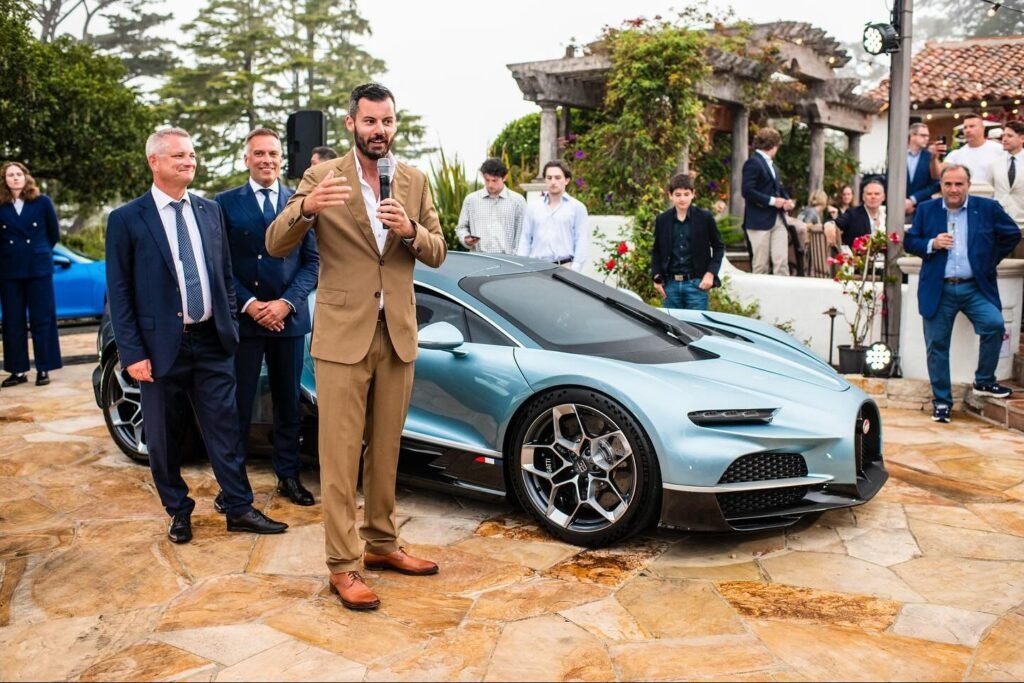
The Bugatti Chiron and the Tourbillon share a name and a price bracket, but under the bodywork they’re two different engineering philosophies. The Tourbillon replaces it with a naturally aspirated 8.3-litre V16 plus three electric motors.
Bugatti Chiron and Tourbillon major changes
The core difference is the engine. Bugatti built the Chiron around its long-running W16 — four banks of four cylinders, force-fed by four turbochargers.
The Tourbillon starts fresh. Combined, the hybrid system pushes total output to roughly 1,800 PS — per Bugatti’s own published figures for the Tourbillon’s powertrain.
Everything else follows from that choice. The Chiron’s turbos need exhaust pressure to spool up, so its gearbox and cooling systems are built around managing heat and lag. The Tourbillon’s motors cover the gap the turbos leave, so the petrol engine can be tuned purely for high-revving drama.
How Do the Key Numbers Compare?
| Specification | Bugatti Chiron | Bugatti Tourbillon |
|---|---|---|
| Engine | 8.0-litre W16, four turbos | 8.3-litre V16, naturally aspirated |
| Electric assistance | None | 3 motors, ~25 kWh battery |
| Combined output | ~1,500 PS | ~1,800 PS |
| Combined torque | ~1,600 Nm | ~2,300 Nm |
| 0–100 km/h | ~2.4 s | ~2.0 s (claimed) |
| Top speed (limited) | 420 km/h | 440 km/h |
| Electric-only range | None | ~25 km |
| Kerb weight | ~1,995 kg | ~1,995 kg (similar) |
Two rows deserve a comment. The weights are nearly identical even though the Tourbillon carries a battery — Bugatti offset that with a lighter carbon structure and a smaller, simpler engine. And the Tourbillon’s higher top speed comes from aerodynamics and gearing as much as power; the Chiron Super Sport 300+ already proved the W16 could exceed 440 km/h in record trim.
Why Did Bugatti Drop the Quad-Turbo Formula?
Emissions rules and character. Turbocharging was the only way to make a huge engine meet emissions limits while producing monster power in 2016. By the time the Tourbillon was designed, hybrid systems let Bugatti keep big-engine performance with a smaller displacement and lower emissions when driving gently.
Tip: Don’t judge these cars by horsepower alone. The Chiron’s 1,600 Nm arrives early and stays; the Tourbillon spreads its 2,300 Nm across electric and petrol sources, which changes how the acceleration feels more than how fast the numbers are.
Which One Is Faster Where It Matters?
On paper, the Tourbillon. Its claimed 0–100 km/h time is around 2.0 seconds against the Chiron’s 2.4, and its limited top speed is about 20 km/h higher. The electric torque also means launches from a standstill are cleaner, because the motors deliver full pull before the petrol engine builds revs.
In real-world driving, the gap shrinks. What you’d actually notice on a road isn’t lap time — it’s the Tourbillon’s sharper response versus the Chiron’s smoother, heavier build of speed.
Is the Tourbillon a Better Car, or Just a Newer One?
Choose the Tourbillon if you want the newest expression of what a hypercar can be: hybrid torque, a screaming V16, and technology that will define Bugatti’s next decade. Neither is a compromise; they’re answers to different questions.
Related guides
- Bugatti Chiron vs Veyron: 10 Technical Performance Verdicts
- Bugatti Chiron Interior Materials Care Tips and Accessories
- Bugatti Chiron Maintenance Costs: What Is Publicly Known?
Frequently Asked Questions
Does the Tourbillon’s battery make it heavier than the Chiron?
No — the weights are close to identical, around 1,995 kg each. Bugatti offset the roughly 25 kWh battery with a lighter carbon-fibre structure and a smaller engine, so the hybrid system adds weight but the rest of the car removes it.
Can the Tourbillon drive on electricity alone?
Yes, for short distances. Bugatti quotes about 25 km of electric-only range, enough for quiet city driving. That’s a convenience feature, not a plug-in commuter car — the petrol V16 remains the main event.
Why does the Tourbillon’s engine rev higher than the Chiron’s?
Because it has no turbochargers. Turbos work best at moderate engine speeds, so the Chiron’s W16 was tuned to make power lower in the rev range. The naturally aspirated V16 breathes freely at high rpm, so it can spin toward 9,000 rpm like a racing engine.
Is the Chiron still relevant now that the Tourbillon exists?
Yes, for a specific reason. The Chiron is the final chapter of the all-petrol W16 era, and its record-setting Super Sport 300+ version was the first production-based car past 300 mph. Collectors and drivers who value that engineering moment won’t see it repeated.
Conclusion
If you’re choosing between them, drive both back to back — the difference isn’t in the spec sheet, it’s in how each car builds speed. And if the Tourbillon interests you most, watch Bugatti’s production updates, since first deliveries and final specifications will settle the last details.