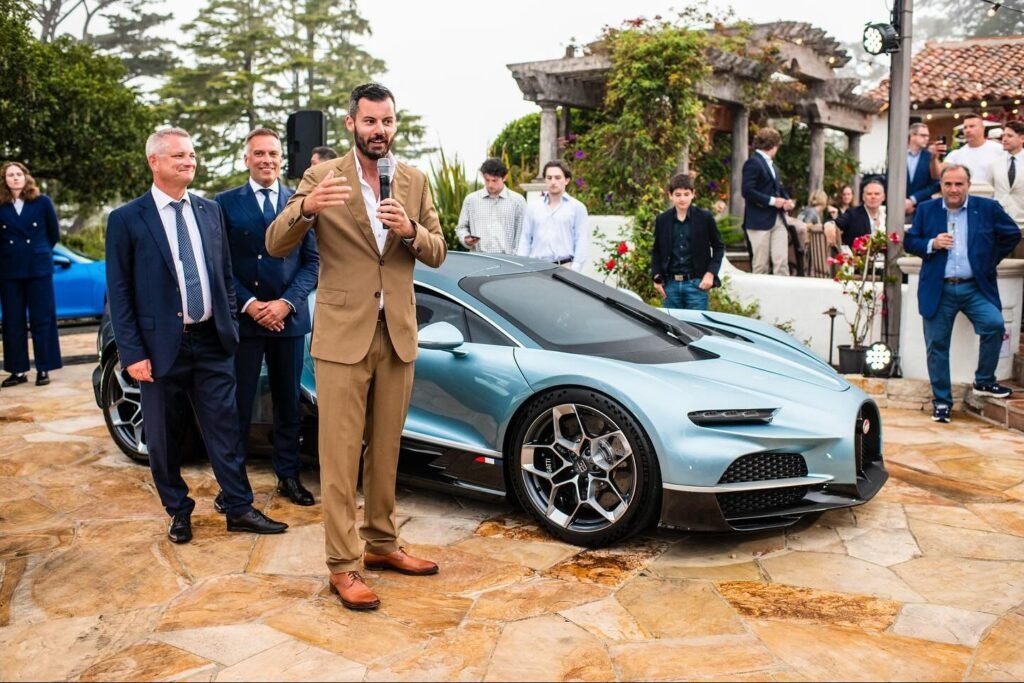
Bugatti’s Chiron and Tourbillon differ in one core way: the Chiron uses a quad-turbocharged W16 petrol engine alone, while the Tourbillon pairs a naturally aspirated V16 with three electric motors. That single change reshapes the engine, the gearbox, the chassis and the way the car delivers its power.
The Main Differences at a Glance
The Chiron’s 8.0-litre W16 makes about 1,500 hp from turbochargers alone. Everything else — weight, cooling, sound, even the shape of the engine bay — follows from that choice.
| Feature | Chiron | Tourbillon |
|---|---|---|
| Engine | 8.0-litre W16, four turbochargers | 8.3-litre V16, naturally aspirated |
| Electric assistance | None | Three motors, small battery |
| Combined output | ~1,500 hp | ~1,800 hp |
| Torque delivery | Instant, from low revs (turbo torque) | Builds with revs, electric fill-in below |
| Gearbox | 7-speed dual-clutch | 8-speed dual-clutch, partly moved to the rear |
| Top speed (limited) | ~420 km/h | ~445 km/h |
| Electric-only driving | Not possible | Yes, short distances at moderate speed |
Bugatti publishes the Tourbillon’s own figures on the official Tourbillon page, which is the place to check exact output and speed numbers for that car.
Why Bugatti Dropped Turbochargers for the Tourbillon
Turbochargers compress exhaust gas to force more air into the engine, which is how the Chiron’s W16 reaches 1,500 hp from a relatively small displacement.
The Tourbillon takes the opposite route. The electric motors cover the low-rev gap. The trade-off: you gain response and sound, and you give up the simplicity of a car with no battery to charge, cool or eventually replace.
How the Chassis and Weight Changed
The Chiron carries a heavy carbon monocoque, a giant fuel tank and the mass of the W16 with its four turbos and intercoolers.
Weight matters more than power at road speeds. A lighter car turns in faster, brakes shorter and puts less strain on its tyres, so the Tourbillon should feel more agile even though both cars are limited far above any legal road speed.
Which One Is Actually Faster?
On paper, the Tourbillon. The Chiron’s Super Sport variants already proved the W16 platform could exceed 440 km/h in testing, so the gap is real but not enormous — both cars are restricted by their tyres, not their engines.
If you’d drive one on public roads, the difference you’d actually feel isn’t top speed.
Is the Chiron Outdated Now?
No — it’s a different philosophy, not an obsolete one. The Tourbillon points at the future, where electrification adds capability the combustion engine can’t reach alone. Collectors and drivers value them for different reasons, and Bugatti built both around that split.
Related guides
- Bugatti Chiron vs Veyron: 10 Technical Performance Verdicts
- Bugatti Chiron Interior Materials Care Tips and Accessories
- Bugatti Chiron Maintenance Costs: What Is Publicly Known?
Frequently Asked Questions
How many Chirons and Tourbillons will Bugatti build?
Bugatti limited the Chiron family to 500 coupés plus additional variants such as the Super Sport. The Tourbillon is limited to 250 units, with deliveries planned for later in the decade. Limited numbers like these are set by the company itself and can change with new variants.
Can the Tourbillon drive on electric power alone?
Yes. Its battery and motors allow short electric-only trips at moderate speeds, something no Chiron can do. The electric range is modest — it’s designed for city crawling and quiet departures, not long silent journeys. When you want full power, the V16 starts automatically.
Why does the Tourbillon use a V16 instead of a V12?
A 16-cylinder layout is Bugatti’s signature, carried over from the Veyron and Chiron. In the Tourbillon it revs higher than the old W16 and spins up to near 9,000 rpm, which gives a sharper sound and stronger response. The cylinder count also lets the engine make serious power without turbochargers.
Do both cars come with all-wheel drive?
Yes. Both send power to all four wheels, which is essential for putting more than 1,500 hp onto the road. The Tourbillon’s front motors also add torque directly to the front axle, giving it a form of four-wheel drive the Chiron achieves mechanically.
Is the Tourbillon faster than the Chiron Super Sport?
In most measures, yes, slightly. The Tourbillon’s combined output is higher and its limited top speed exceeds the standard Chiron’s. The Chiron Super Sport was built specifically for high-speed running and reached beyond 440 km/h in testing, so the two are closer than the headline numbers suggest.
Conclusion
If you want to judge the engineering shift yourself, watch official Bugatti footage of both cars accelerating — the Chiron’s turbocharged surge and the Tourbillon’s instant electric launch tell the story better than any spec sheet. Then check the manufacturer’s pages for the latest figures, because final production details can still change.